



Cats are naturally mysterious, playful, and sometimes completely confusing. One minute your cat is calmly sitting by the window, and the next minute it is running across the room like it has seen a ghost. Cats often do things that make us laugh, but many of these funny behaviors have real meanings behind them.
From sudden zoomies to knocking things off tables, cats use body language, sound, movement, and daily habits to communicate. What looks silly to humans may be a normal instinct, a sign of affection, a request for attention, or even a way to release energy.
Understanding funny cat behavior helps you build a stronger bond with your pet. It also helps you know when your cat is simply being playful and when a behavior might need attention.
In this guide, we will explore the most common funny things cats do and what they actually mean.
Why Cats Do Funny and Strange Things
Cats are not random, even when they seem random. Many of their strange behaviors come from natural instincts that go back to their wild ancestors. Even indoor cats still have hunting instincts, territory habits, grooming routines, and social behaviors.
A cat may look like it is being dramatic, but it may actually be:
- Releasing extra energy
- Marking territory
- Asking for attention
- Showing affection
- Practicing hunting skills
- Feeling curious
- Responding to stress
- Trying to feel safe
The more you observe your cat, the easier it becomes to understand its personality and habits.
Cats Communicate Through Behavior
Cats do not speak like humans, but they communicate all the time. Their tail position, ear movement, eye contact, meows, purring, scratching, and even sleeping spots can tell you a lot.
Funny cat behaviors are often messages. Your cat may be saying, “I trust you,” “I am bored,” “This is mine,” “Feed me,” or “Please pay attention.”
Funny Things Cats Do and What They Mean
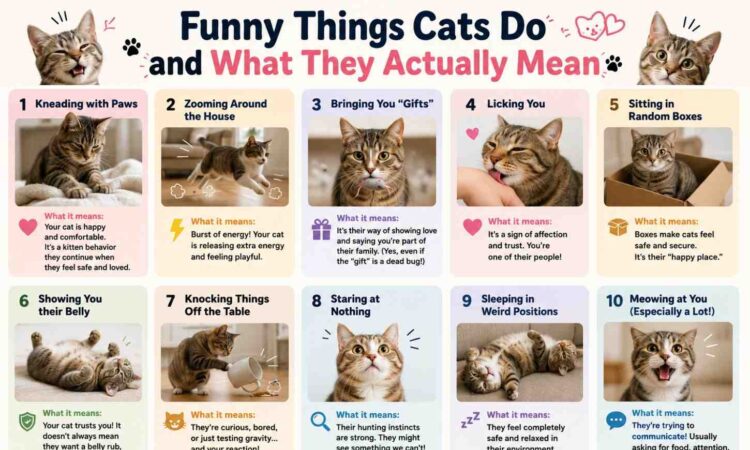
1. Sudden Zoomies Around the House
One of the funniest things cats do is run wildly around the house for no obvious reason. This is often called the “cat zoomies.”
Your cat may sprint down the hallway, jump on furniture, race in circles, and then suddenly stop like nothing happened.
What it means
Zoomies usually mean your cat has extra energy to burn. Indoor cats may not get enough chances to run, hunt, and climb during the day, so they release energy in quick bursts.
Zoomies are especially common:
- Early in the morning
- Late at night
- After using the litter box
- After long naps
- When a cat is excited
Most zoomies are normal. However, if your cat seems distressed, vocalizes in pain, or acts unusually restless, it may be worth checking with a vet.
2. Kneading with Their Paws
Many cats press their paws in and out on soft surfaces like blankets, pillows, your lap, or even your stomach. This behavior is called kneading.
It may look funny, especially when your cat looks serious while doing it.
What it means
Kneading is usually a sign of comfort and happiness. Kittens knead their mother’s belly while nursing, so adult cats may continue this behavior when they feel safe and relaxed.
Your cat may knead because it is:
- Feeling happy
- Getting comfortable
- Showing affection
- Marking territory with scent glands in the paws
- Remembering kittenhood comfort
If your cat kneads on you, it often means you are part of its safe space.
3. Staring at You Without Blinking
Sometimes cats stare at their owners like they are judging every life decision. It can be funny, strange, and slightly uncomfortable.
What it means
A cat’s stare can mean different things depending on body language.
If your cat is relaxed and slowly blinking, it is showing trust and affection. Slow blinking is sometimes called a “cat kiss.”
If your cat is staring with wide eyes, stiff posture, or a twitching tail, it may be alert, overstimulated, or focused on something.
Your cat may stare because it wants:
- Food
- Attention
- Playtime
- Your reaction
- To understand what you are doing
If your cat gives you slow blinks, try slowly blinking back. It is a gentle way to communicate trust.
4. Knocking Things Off Tables
Many cat owners know this behavior too well. Your cat walks across a table, looks at a pen, cup, or small object, taps it once, and then pushes it to the floor.
It can be funny until it happens to something fragile.
What it means
Cats knock things over for several reasons. They may be testing objects, practicing paw movement, getting your attention, or simply enjoying the reaction.
In the wild, cats use their paws to investigate prey. Indoor cats may use the same instinct on household objects.
Your cat may knock things off because:
- It is curious
- It wants attention
- It is bored
- It enjoys movement
- It learned that you react quickly
If this becomes a problem, provide puzzle toys, playtime, and safe objects your cat is allowed to bat around.
5. Sleeping in Boxes
You can buy the most expensive cat bed, and your cat may still choose the cardboard box it came in. This is one of the most classic funny cat behaviors.
What it means
Boxes make cats feel safe. A box provides a small, enclosed space where a cat can hide, observe, and relax.
Cats love boxes because they offer:
- Security
- Warmth
- Privacy
- A hiding place
- A hunting spot
- Stress relief
For cats, a simple box can feel like a cozy little fortress.
6. Chattering at Birds
If your cat sits by the window and makes a strange chattering or clicking sound while watching birds, you are not alone. Many cats do this.
What it means
Chattering is usually connected to hunting excitement. Your cat sees prey, such as birds or squirrels, but cannot reach it.
The sound may show:
- Excitement
- Frustration
- Hunting instinct
- Focus and alertness
It is a normal behavior and usually nothing to worry about. A window perch can give your cat safe entertainment, especially if it is an indoor cat.
7. Bringing You “Gifts”
Some cats bring toys, socks, insects, or even hunted prey to their owners. While this may not always be pleasant, it is often meaningful.
What it means
Your cat may be sharing its “catch” with you. This behavior is linked to hunting and social bonding.
Your cat may bring gifts because it wants to:
- Show hunting success
- Share something valuable
- Get praise
- Teach you how to hunt
- Bond with you
If your cat brings toys, praise it gently. If your cat brings real prey, avoid punishment. Instead, manage outdoor access or provide more hunting-style play indoors.
8. Sitting on Your Laptop or Book
Many cats love sitting directly on the thing you are using. Laptop, notebook, book, phone, paperwork—if you need it, your cat may sit on it.
What it means
Your cat may want attention, warmth, or closeness. Laptops are warm, books smell like you, and your focus is on that object. Your cat may simply be saying, “Look at me instead.”
This behavior can mean:
- Your cat wants attention
- Your cat likes the warmth
- Your cat wants to be near your scent
- Your cat is curious about what you are doing
Try placing a cozy cat bed near your workspace so your cat can stay close without blocking your work.
9. Showing Their Belly
When a cat rolls over and shows its belly, many people think it is asking for a belly rub. Sometimes it is. Many times, it is not.
What it means
A cat’s belly is a vulnerable area. When your cat shows it, it often means trust. Your cat feels safe enough to expose its soft underside.
However, this does not always mean your cat wants to be touched there.
Belly showing can mean:
- Trust
- Relaxation
- Playfulness
- Stretching
- A warning before playful grabbing
If your cat grabs your hand when you touch its belly, it probably wanted admiration, not a belly rub.
10. Following You to the Bathroom
Many cats insist on following their owners into the bathroom. It may seem strange, but to cats, closed doors are very suspicious.
What it means
Your cat may follow you because it wants attention, feels curious, or dislikes being separated from you.
Bathroom behavior may mean:
- Your cat wants to stay near you
- It dislikes closed doors
- It is curious about water sounds
- It knows you cannot easily ignore it there
- It feels bonded to you
For many cats, privacy is a human concept, not a feline one.
11. Rubbing Their Face on You
Cats often rub their cheeks, head, or body against people, furniture, and objects. It may look like affection, and it often is.
What it means
Cats have scent glands around their face. When they rub on you, they are marking you with their scent.
This behavior usually means:
- “You belong to my safe group”
- “I trust you”
- “This is familiar”
- “I feel comfortable here”
Face rubbing is one of the sweetest signs of cat affection.
12. Sleeping in Weird Positions
Cats can sleep in positions that look impossible. Curled into a tiny ball, stretched like liquid, upside down, half falling off furniture—cats seem to have no rules.
What it means
A cat’s sleeping position often reflects comfort, temperature, and safety.
For example:
- Curled up: staying warm and protected
- Belly exposed: feeling safe
- Loaf position: relaxed but alert
- Stretched out: comfortable and warm
- Hiding while sleeping: wanting security
If your cat sleeps near you or in a relaxed position, it usually means it feels safe in your home.
When Funny Cat Behavior Is Normal
Most funny cat behaviors are completely normal. Cats are playful, curious, and full of personality. A cat that zooms, kneads, chirps, hides in boxes, or knocks around toys is usually expressing natural behavior.
Normal funny behavior usually happens when your cat is:
- Eating normally
- Using the litter box normally
- Playing and resting normally
- Socializing as usual
- Showing no signs of pain
- Maintaining a healthy routine
If your cat seems happy and healthy, its strange habits are often just part of its personality.
When Strange Cat Behavior May Be a Warning Sign
Some behaviors may look funny at first but can signal stress or illness if they suddenly appear or become extreme.
Watch for warning signs such as:
- Sudden hiding
- Loss of appetite
- Excessive meowing
- Aggression
- Litter box accidents
- Overgrooming
- Repeated vomiting
- Sudden restlessness
- Drinking much more water
- Difficulty urinating
If your cat’s behavior changes suddenly, contact a veterinarian. Cats often hide pain, so behavior changes can be an early clue.
How to Understand Your Cat Better
The best way to understand your cat is to watch patterns. One behavior alone may not tell the full story. Look at the whole picture: body language, routine, appetite, litter habits, energy level, and mood.
Helpful tips:
- Learn your cat’s normal habits
- Pay attention to tail and ear position
- Respect your cat’s boundaries
- Provide daily playtime
- Offer scratching posts and hiding spots
- Keep feeding and litter routines consistent
- Avoid punishment for natural behaviors
- Reward calm and positive behavior
Cats are easier to understand when you stop expecting them to act like dogs or humans. They have their own language, and once you learn it, their funny actions become much more meaningful.
FAQ Section
Why do cats get zoomies at night?
Cats often get zoomies at night because they have extra energy. Cats are naturally more active during dawn and dusk, so evening or late-night energy bursts are common.
Why does my cat knead me?
Your cat may knead you because it feels safe, relaxed, and affectionate. Kneading is a comforting behavior that begins in kittenhood.
Why does my cat stare at me?
Your cat may stare because it wants food, attention, play, or simply wants to observe you. If your cat slow blinks while staring, it is often a sign of trust.
Why do cats knock things off tables?
Cats may knock things off tables because they are curious, bored, practicing hunting behavior, or trying to get your attention.
Why does my cat sleep in a box instead of its bed?
Boxes make cats feel safe, warm, and hidden. A box gives your cat a secure space to rest and observe its surroundings.
Why does my cat follow me everywhere?
Your cat may follow you because it feels attached to you, wants attention, or is curious about what you are doing.
Does showing the belly mean my cat wants a belly rub?
Not always. Showing the belly often means trust, but many cats do not like belly rubs. Watch your cat’s body language before touching.
When should I worry about strange cat behavior?
You should worry if the behavior is sudden, extreme, or comes with signs like hiding, appetite loss, litter box problems, aggression, vomiting, or low energy.
Conclusion
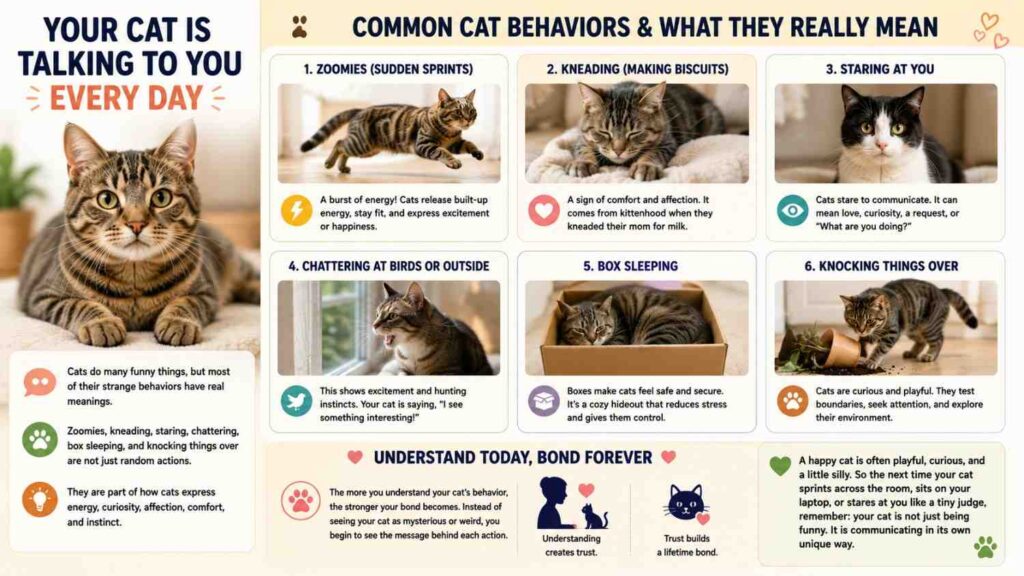
Cats do many funny things, but most of their strange behaviors have real meanings. Zoomies, kneading, staring, chattering, box sleeping, and knocking things over are not just random actions. They are part of how cats express energy, curiosity, affection, comfort, and instinct.
The more you understand your cat’s behavior, the stronger your bond becomes. Instead of seeing your cat as mysterious or weird, you begin to see the message behind each action.
A happy cat is often playful, curious, and a little silly. So the next time your cat sprints across the room, sits on your laptop, or stares at you like a tiny judge, remember: your cat is not just being funny. It is communicating in its own unique way.

