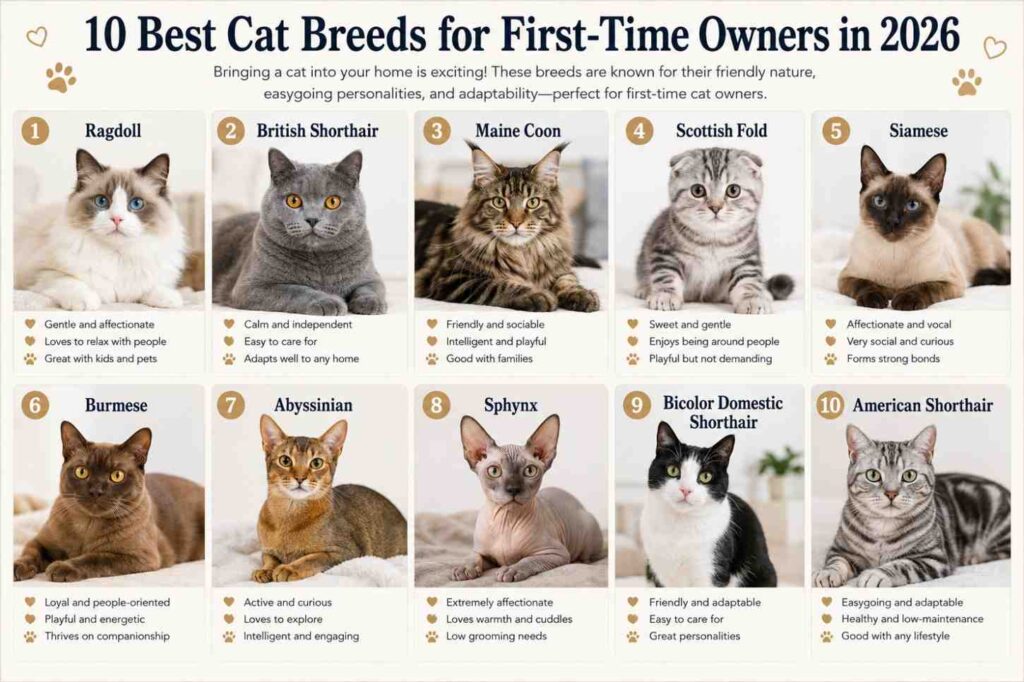


Bringing home your first cat feels exciting, right? One moment you are imagining cozy evenings with a furry friend curled beside you, and the next moment you are drowning in questions. Which cat breed is friendly? Which one is easy to care for? Will your future feline turn into a calm cuddle buddy or a tiny whirlwind knocking plants off shelves at 3 a.m.?
Choosing the right cat breed as a beginner matters more than many people realize. Some cats are naturally laid-back, affectionate, and forgiving of rookie mistakes. Others demand constant stimulation, extensive grooming, or highly experienced handling. Think of it like learning to drive—you probably would not want your first car to be a complicated race machine. A beginner-friendly cat can make the experience smoother, less stressful, and far more enjoyable.
Veterinary recommendations and recent pet-care discussions in 2026 consistently highlight calm temperaments, manageable grooming needs, and adaptable personalities as the most important traits for first-time owners. Breeds such as Ragdolls, British Shorthairs, and Maine Coons continue ranking among the easiest cats for beginners because of their affectionate nature and low-stress behavior. Personality still matters more than breed alone, but choosing wisely gives you a better starting point. (Catworder)
Why Choosing the Right Cat Breed Matters for Beginners
Not all cats are created equal. Some cats practically train themselves to fit into your life, while others expect you to revolve around theirs. If this is your first experience owning a cat, selecting the wrong breed can turn excitement into frustration pretty quickly.
Beginner-friendly cats often share a few important qualities. They are usually adaptable, moderately playful, and social without being overly needy. Many experts also recommend breeds with manageable grooming requirements and fewer complicated health concerns for new owners. Cats that tolerate change well are especially helpful because first-time owners often make mistakes during feeding, litter training, or adjusting routines. A patient cat can make those learning moments much easier. (Clawmate)
Traits That Make a Cat Beginner-Friendly
Here are the traits worth prioritizing if you are new to cat ownership:
| Trait | Why It Matters for Beginners |
|---|---|
| Friendly personality | Easier bonding and social interaction |
| Moderate activity | Less destructive behavior |
| Easy grooming | Saves time and stress |
| Adaptability | Adjusts better to homes and schedules |
| Good health | Fewer surprise medical concerns |
Of course, no breed guarantees a perfect personality. Even within the same breed, every cat behaves differently. Still, certain breeds tend to lean toward calmer, easier companionship.
1. Ragdoll – The Gentle Companion
If cats had a category for “easy mode,” the Ragdoll would probably win first place. These fluffy beauties are famous for their relaxed, affectionate personalities. Many owners jokingly call them “puppy cats” because they often follow humans around the house.
What makes them beginner-friendly? For starters, Ragdolls are famously patient and calm. They rarely act aggressively and generally enjoy cuddles and companionship. Unlike some independent cats that act like tiny landlords collecting rent, Ragdolls genuinely enjoy human interaction.
Their long coat may look intimidating, but surprisingly, grooming is not as overwhelming as people think. Weekly brushing often keeps tangles under control. If you want a gentle cat that feels more like a relaxed roommate than a chaotic tornado, this breed deserves serious consideration. (purrfectclaws.com)
2. British Shorthair – Calm and Low-Maintenance
The British Shorthair is basically the introvert of the cat world—and that is not a bad thing. These cats are calm, independent, and wonderfully low-maintenance, making them excellent companions for busy people or apartment dwellers.
Unlike highly demanding breeds, British Shorthairs enjoy companionship without needing nonstop attention. They are affectionate but usually not clingy. Imagine having a roommate who likes hanging out but also respects personal space. That is pretty much their vibe.
One major advantage for beginners is grooming. Their short, dense coat requires minimal maintenance compared to long-haired breeds. They also tend to adapt well to indoor living and quieter households. Many first-time owners appreciate their balanced energy levels because they are playful without turning the living room into a demolition zone. (Catworder)
3. Maine Coon – The Gentle Giant
The Maine Coon looks intimidating at first because of its size, but personality-wise, these cats are giant softies. Often called “gentle giants,” they are known for friendliness, patience, and strong family bonds.
One reason beginners love Maine Coons is their adaptability. They generally get along with children, visitors, and even other pets. Their playful side makes life entertaining, but they rarely become overwhelming. They are curious without being destructive.
The only thing to keep in mind? Grooming. Their thick fur needs regular brushing to prevent mats and shedding. Think of it like maintaining long hair—it takes consistency but becomes manageable with routine. If you do not mind brushing, a Maine Coon can become an unforgettable first pet. (purrfectclaws.com)
4. American Shorthair – Easygoing and Adaptable
Sometimes the best option is also the simplest one. The American Shorthair has earned a reputation for being one of the easiest breeds to care for, especially for beginners.
These cats are friendly, adaptable, and surprisingly independent. They enjoy human interaction without becoming emotionally overwhelming. Busy work schedule? No problem. Lazy weekend? Also fine. American Shorthairs adapt remarkably well to different lifestyles.
Health-wise, they are generally robust and require less maintenance than many fancy breeds. Their short coat means grooming stays simple, usually needing just occasional brushing. For first-time owners nervous about making mistakes, this breed offers a forgiving learning curve. (Petworks)
5. Birman – Friendly and Affectionate
The Birman is often overlooked, which feels unfair because these cats are genuinely wonderful for beginners. They are affectionate without becoming clingy and social without being overly loud.
Birmans enjoy human company and usually settle comfortably into family life. Unlike highly vocal breeds, they communicate softly and calmly. This makes them ideal for people who want companionship without constant demands.
Their silky coat does require some brushing, but not nearly as much as people assume. Because their fur tangles less than many long-haired breeds, maintenance remains relatively easy. If you want a loving but balanced personality, the Birman deserves a closer look. (Lux Cat Living)
6. Russian Blue – Quiet and Loyal
Some people want an energetic entertainer. Others want peace and quiet. If you belong to the second group, the Russian Blue might feel perfect.
Russian Blues are often described as loyal, calm, and intelligent. They bond deeply with their families but are usually reserved around strangers. Think of them as the friend who does not trust everyone immediately but becomes incredibly loyal once comfortable.
Their short plush coat requires very little grooming, making maintenance easy for beginners. They also tend to prefer stable routines, which helps create a calm household atmosphere. For apartment living or quieter homes, Russian Blues fit beautifully. (Lux Cat Living)
7. Burmese – Playful Yet Loving
Want a cat with personality? The Burmese breed brings fun into everyday life. These cats are playful, social, and affectionate without becoming impossible to handle.
Burmese cats love companionship and tend to bond strongly with humans. If you work from home or spend plenty of time indoors, they can make fantastic companions. Their energy level sits somewhere in the middle—not too wild, not too lazy.
Their short coat also makes grooming refreshingly easy. For first-time owners wanting an affectionate cat that actually enjoys interaction, Burmese cats strike a lovely balance between entertainment and companionship. (Lux Cat Living)
8. Exotic Shorthair – Persian Looks Without the Work
Ever loved the look of a Persian cat but feared the grooming nightmare? Meet the Exotic Shorthair.
Often described as “the lazy person’s Persian,” this breed combines adorable flat-faced looks with a much shorter coat. That means less brushing, fewer tangles, and significantly less maintenance.
Exotic Shorthairs are usually calm, affectionate, and well-suited for indoor life. They enjoy cuddling but also appreciate peaceful independence. For beginners wanting a relaxed cat without daily grooming struggles, this breed offers an excellent middle ground. (YouTube)
9. Siamese – Intelligent and Social
The Siamese cat is not for everyone—but for the right beginner, they can be amazing. These cats are intelligent, highly social, and incredibly interactive.
Siamese cats love “talking” to humans. Seriously, if you dislike vocal pets, this might not be your match. But if you enjoy personality and interaction, their conversational nature becomes part of the charm.
Because they crave attention, they thrive in households where people are around regularly. Think of them as the extrovert friend who wants constant conversation. For social owners, Siamese cats can become deeply rewarding companions. (YouTube)
10. Domestic Shorthair – The Shelter Superstar
Sometimes, the perfect cat has no fancy breed name at all. The Domestic Shorthair—often found in shelters—can be one of the smartest choices for beginners.
Why? They are generally healthy, low-maintenance, and widely available. Their personalities vary, but many shelters help match cats based on temperament. Instead of choosing only by looks, you can find a cat whose personality genuinely matches your lifestyle.
Many experienced owners and online communities actually recommend adult Domestic Shorthairs for first-time owners because temperament becomes easier to predict. It is a practical, affordable, and heartwarming choice. (reddit.com)