



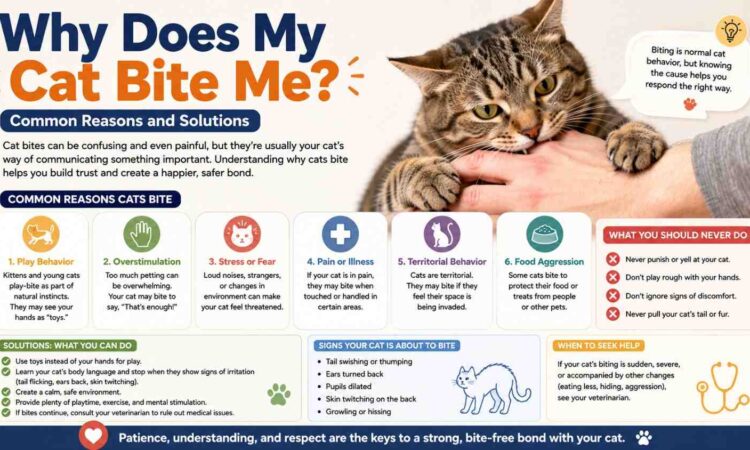
Understanding Cat Biting
If you have ever asked, “Why does my cat bite me?”, you are definitely not alone. One minute your cat is curled up beside you like a tiny loaf of bread, and the next minute those little teeth are wrapped around your hand. It can feel confusing, personal, and honestly a little rude. But here is the truth: most cat biting is not your cat being “bad.” It is communication. Cats do not have words, so they use body language, movement, claws, and teeth to say things like “I’m overstimulated,” “I’m scared,” “That hurts,” or “I want to play.”
The tricky part is that cat bites can mean different things depending on the moment. A kitten biting your fingers during play is not the same as an older cat suddenly biting when touched near the hips. A gentle nibble during cuddles is not the same as a hard bite after your cat sees another animal outside the window. That is why context matters so much. Instead of asking only, “How do I stop my cat from biting?”, the better question is, “What is my cat trying to tell me before the bite happens?” Once you understand the message, the solution becomes much easier.
Is Cat Biting Always Aggression?
No, cat biting is not always aggression, although it can look aggressive from the human side of things. Cats bite during play, grooming, exploration, defense, fear, pain, frustration, and overstimulation. Think of a bite like a smoke alarm. Sometimes it means there is a real fire, and sometimes it means the toast got a little too crispy. Either way, it is a signal worth paying attention to. Your job is not to punish the signal; your job is to figure out what triggered it.
This is especially important because punishment can make biting worse. Yelling, tapping your cat, spraying water, or grabbing them may teach your cat that hands are scary. That can increase fear-based biting and damage trust. A better approach is calm prevention. Watch your cat’s body language, stop interactions before they escalate, and redirect energy into safe outlets. Cats learn best when they feel safe, not when they feel cornered.
Why Context Matters
Context is everything when it comes to why cats bite their owners. Ask yourself what was happening right before the bite. Were you petting your cat for a long time? Were you using your hand as a toy? Did your cat hear a loud noise? Was there a visitor, a new pet, or another cat outside? Did the bite happen during grooming, nail trimming, or when you touched a certain body area? These little details are like puzzle pieces, and together they reveal the real cause.
For example, if your cat bites only during belly rubs, the solution may be simple: stop touching the belly. If your cat bites ankles every evening, they may need more structured play before dinner. If your cat suddenly starts biting after years of being gentle, pain or illness should be considered. Cats are masters at hiding discomfort, so sudden behavior changes should never be ignored. When you understand the setting, you can stop guessing and start helping.
Common Reasons Cats Bite Their Owners
There are several common reasons behind cat biting behavior, and each one needs a slightly different solution. That is where many cat owners go wrong. They treat every bite the same way, but a playful kitten, an anxious rescue cat, and a senior cat with sore joints are not biting for the same reason. Imagine trying to fix every car problem with more fuel. Sometimes the issue is the battery, sometimes it is the tires, and sometimes the engine needs a mechanic.
The good news is that most biting problems can improve with patience, observation, and small changes at home. Cats are creatures of rhythm. They like predictable routines, safe spaces, and respectful handling. When their needs are met, many biting behaviors become less frequent. You do not need to “dominate” your cat or win some imaginary battle. You need to build a better conversation.
Play Biting
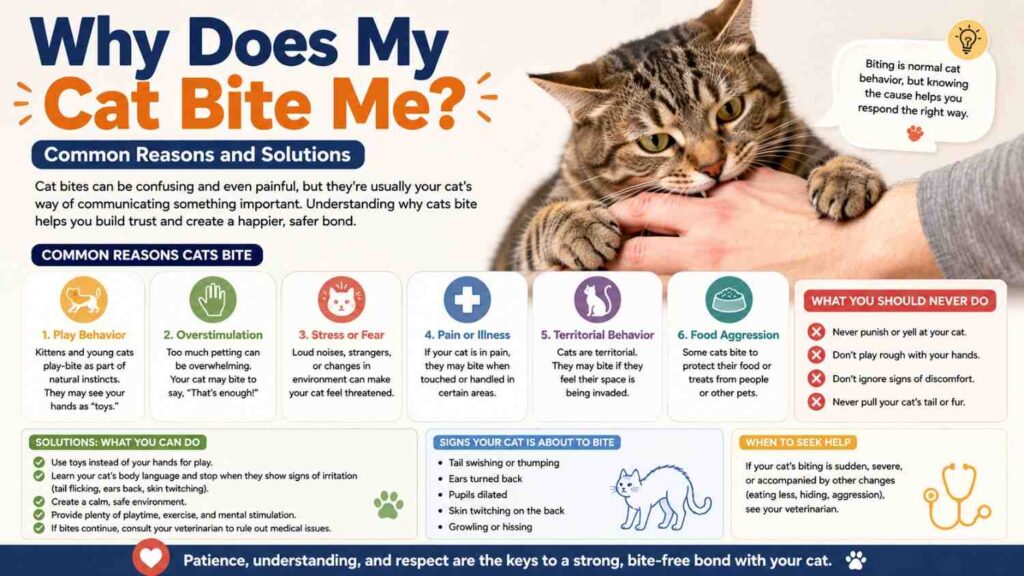
Play biting is one of the most common reasons cats bite, especially kittens and young cats. In the wild, cats practice hunting through play. They stalk, pounce, grab, kick, and bite. Your indoor cat still has those instincts, even if their “prey” is a feather wand, a toy mouse, or unfortunately, your hand. If you wiggle your fingers under a blanket, your cat may not see “beloved human hand.” They may see “mysterious prey creature that must be attacked immediately.”
The solution is to stop using hands and feet as toys. This rule matters even when your kitten is tiny and the bites do not hurt yet. What feels cute at eight weeks can become painful at eight months. Use wand toys, kicker toys, rolling balls, and puzzle feeders instead. Give your cat daily play sessions that mimic hunting: chase, catch, bite, and then eat. This helps satisfy their natural drive in a safe way. If your cat attacks your hand, freeze, calmly remove attention, and redirect to a toy. The message should be clear: toys are for biting, people are not.
Petting Overstimulation
Many cat owners experience this classic situation: your cat climbs into your lap, purrs, enjoys petting, and then suddenly bites. This is often called petting-induced aggression or overstimulation. It does not always mean your cat hates being touched. It may mean they enjoy petting for a short time, but after a certain point, the sensation becomes too much. Think of it like someone scratching your back. Nice at first, annoying after too long, unbearable if they do not stop.
Cats usually give warnings before an overstimulation bite, but humans often miss them. The tail may twitch. The ears may rotate back. The skin along the back may ripple. The cat may turn their head toward your hand, tense their body, or stop purring. Once you notice these signs, stop petting immediately. Let your cat decide whether to stay or leave. Keep petting sessions short, focus on areas many cats prefer like the cheeks and chin, and avoid sensitive zones like the belly, paws, and base of the tail unless your cat clearly enjoys it.
Love Bites
Some cats give gentle little nibbles that people call love bites. These bites usually do not break skin, and they often happen during relaxed moments. Your cat may be grooming you, cuddling, or giving a soft nibble as part of social interaction. It can be their odd little way of saying, “You are part of my circle.” Sweet? Yes. Still teeth? Also yes.
Even gentle love bites should have boundaries if they hurt or become too intense. You do not need to punish your cat for them, but you can calmly pause the interaction. Move your hand away slowly and give your cat a soft toy or blanket instead. Avoid pulling your hand away quickly because fast movement can trigger a stronger grab. If your cat learns that gentle behavior keeps attention going while biting ends attention, they can adjust over time. Cats are smart; they notice patterns.
Fear or Stress
Fear is another major reason cats bite. A scared cat may bite because they feel trapped, threatened, or overwhelmed. This can happen with visitors, loud sounds, children, dogs, carriers, vet visits, or sudden handling. From your point of view, you may simply be trying to pick up your cat. From your cat’s point of view, a giant creature just reached down and removed all escape options. That is scary.
A fear bite is usually defensive. The cat may crouch, flatten their ears, hiss, growl, widen their eyes, or try to hide first. The best solution is to give them space. Do not force contact. Create hiding spots, vertical spaces, and quiet areas where your cat can retreat. Let your cat approach on their own terms. For nervous cats, confidence grows slowly, like a plant. You cannot yank it taller; you have to give it the right environment and time.
Pain or Illness
A cat that suddenly starts biting may be in pain. This is especially important if the biting is new, intense, or linked to touching a specific area. Dental pain, arthritis, skin irritation, injuries, digestive discomfort, ear problems, and other medical issues can make a normally gentle cat react sharply. Cats often hide pain because, in nature, showing weakness can be dangerous. So instead of crying dramatically like a movie character, your cat may simply bite when something hurts.
If your cat’s behavior changes suddenly, book a veterinary checkup. This is not overreacting; it is responsible cat care. Pay attention to other signs too, such as hiding, reduced appetite, litter box changes, overgrooming, limping, bad breath, or avoiding jumps. Solving the medical issue may reduce or stop the biting. Training cannot fix pain. You have to treat the cause, not just the symptom.
Redirected Aggression
Redirected aggression happens when your cat gets upset by something they cannot reach, then bites the nearest available target. For example, your indoor cat sees a strange cat outside the window. They become highly aroused, but they cannot get to that outdoor cat. Then you walk by and suddenly get bitten. It feels random, but to your cat, the emotional pressure had already built up like steam in a kettle.
The best solution is to identify and reduce the trigger. Close blinds if outdoor cats are causing stress. Use motion-activated deterrents outside if safe and appropriate. Separate cats after a tense event and give them time to calm down. Do not try to pick up or comfort a highly aroused cat with your hands. That is like hugging someone in the middle of a panic sprint. Wait until your cat’s body relaxes before interacting again.
Territory and Routine Changes
Cats are deeply attached to territory and routine. New furniture, moving house, a new baby, a new pet, guests, construction noise, or even a changed feeding schedule can create stress. When stress builds, biting may appear as part of a bigger behavior shift. Your cat may also hide more, mark with urine, groom excessively, or become clingier than usual.
To help, make changes gradually whenever possible. Keep feeding, playtime, and litter box routines consistent. Give your cat safe zones where no one bothers them. In multi-cat homes, provide enough resources so cats do not have to compete. A helpful rule is one litter box per cat plus one extra, along with multiple food, water, scratching, and resting areas. A secure cat is usually a calmer cat, and a calmer cat is less likely to bite.
Warning Signs Before a Cat Bite
Cats rarely bite “out of nowhere,” although it can feel that way. Most cats give small warnings first. The problem is that their warning signs can be subtle, especially compared with dogs. A dog may bark, growl, or move away dramatically. A cat may simply flick the tail, shift weight, or turn the ears slightly. If you miss the whisper, you may hear the shout.
Learning cat body language is one of the best ways to prevent bites. It helps you stop before your cat feels forced to escalate. You become less like someone ignoring a stop sign and more like someone reading traffic properly. The better you read your cat, the safer and more trusting your relationship becomes.
Body Language to Watch
Watch for a twitching or thumping tail, flattened or sideways ears, dilated pupils, rippling back skin, tense muscles, sudden stillness, head-turning toward your hand, growling, hissing, or repeated attempts to move away. These are signs your cat may be uncomfortable, overstimulated, afraid, or irritated. When you see them, stop what you are doing.
Do not wait for the bite to prove your cat was serious. Respect the early signal. If your cat learns that small warnings work, they may not need to use bigger warnings. That is a huge win. It means your cat trusts you to listen.
When Purring Does Not Mean “Happy”
Purring usually means contentment, but not always. Cats may also purr when stressed, uncomfortable, or trying to self-soothe. So if your cat is purring while their tail is lashing and their ears are back, do not assume everything is fine. Look at the whole body, not just one signal.
This is where many people get confused. They say, “But my cat was purring right before biting me!” That can happen. The purr may have started during enjoyment, while the body later shifted into overstimulation. Cat communication is layered. One signal is a word; the whole body is the sentence.
How to Stop Your Cat From Biting
Stopping cat biting is not about one magic trick. It is about creating a home where your cat has safe outlets, clear boundaries, and less stress. You want to prevent the bite before it happens, not react dramatically after it happens. Prevention is always easier than repair.
The most effective approach is calm, consistent, and respectful. Do not hit, yell, chase, or scare your cat. These reactions can increase anxiety and make biting worse. Instead, redirect play, stop petting before overstimulation, reward calm behavior, and check for health problems when needed. Small daily habits can change the entire relationship.
Use Toys, Not Hands
The first rule is simple: never use your hands as cat toys. Hands should mean petting, feeding, care, and safety. Toys should mean stalking, grabbing, biting, and bunny-kicking. When you separate those categories, your cat gets a clearer message.
Use wand toys to keep distance between your skin and your cat’s teeth. Let your cat chase and catch the toy so the game feels satisfying. End play with a small meal or treat to complete the hunting cycle. For cats that bite ankles, schedule active play before the usual attack time. If the biting happens every evening, your cat may be telling you they have unused energy. Drain the battery before the zoomies become ankle ambushes.
Respect Petting Limits
Every cat has a petting limit. Some cats enjoy long cuddle sessions, while others prefer three chin scratches and then personal space. Neither cat is wrong. They are just different. Your job is to learn your cat’s number.
Try counting how many strokes your cat enjoys before showing tension. Stop before that point and offer a treat or calm praise. Over time, your cat may tolerate more, but do not rush. Avoid forcing affection. A cat that chooses contact will usually be more relaxed than a cat that feels trapped in it.
Reduce Stress at Home
Stress reduction can make a big difference in biting behavior. Give your cat hiding places, scratching posts, climbing spaces, window views, and predictable routines. Cats feel safer when they can control distance and escape routes. A home without vertical space can feel like a flat, exposed field. A cat tree or shelf can become a watchtower.
In multi-cat homes, reduce competition. Provide separate feeding spots, multiple litter boxes, and enough resting areas. If cats are fighting, do slow reintroductions instead of forcing them to “work it out.” Cats do not solve conflict through awkward family meetings. They need scent swapping, distance, positive associations, and time.
Reward Calm Behavior
Reward the behavior you want to see more often. If your cat sits calmly near you without biting, offer praise, a treat, or gentle attention if they enjoy it. If your cat plays with a toy instead of your hand, make that toy exciting. Cats repeat behaviors that work.
Avoid rewarding biting by turning it into a game. If your cat bites and you squeal, wave your hand, or chase them, they may find that thrilling. Instead, become boring. Pause, withdraw attention calmly, and redirect when appropriate. The goal is not drama; the goal is clarity.
When to Call a Vet or Behaviorist
Call a vet if biting starts suddenly, becomes severe, breaks skin, happens when touching a specific area, or appears with other health changes. You should also seek help if your cat seems fearful most of the time, attacks without calming down, or creates safety concerns for children, elderly people, or other pets. A professional can help identify whether the issue is medical, behavioral, environmental, or a mix.
A certified cat behaviorist or veterinary behaviorist can also help with complex cases. This is especially useful for redirected aggression, inter-cat conflict, trauma-related fear, or long-term biting patterns. Getting help does not mean you failed. It means you are taking your cat’s communication seriously.
Sudden Biting Needs Attention
Sudden biting is the biggest red flag. If a cat who has always been gentle begins biting, do not assume they developed a bad attitude overnight. Pain, stress, or illness may be involved. Cats are subtle, and behavior changes are often the first visible clue.
Keep a simple bite diary for a week. Write down the time, location, trigger, body language, bite intensity, and what happened afterward. This gives your vet or behaviorist useful information. Patterns are easier to solve when they are written down instead of floating around in memory.
Conclusion
So, why does your cat bite you? The answer depends on the situation. Your cat may be playing, overstimulated, afraid, stressed, in pain, protecting territory, or reacting to something else entirely. The bite is not the whole story; it is the final sentence in a conversation that started earlier.
The best solution is to listen sooner. Watch body language, stop using hands as toys, respect petting limits, reduce household stress, and get veterinary help when biting is sudden or intense. Your cat is not trying to ruin your day. They are trying to communicate in the only way they know. When you learn their language, life together becomes calmer, safer, and much sweeter.
FAQs
1. Why does my cat bite me gently?
Gentle biting can be a love bite, grooming behavior, play behavior, or a mild warning that your cat is getting overstimulated. Look at the full context. If your cat is relaxed and the bite is soft, it may be social. If their tail is twitching or their body is tense, stop touching them and give space.
2. Why does my cat bite me when I pet her?
Your cat may be experiencing petting overstimulation. Some cats enjoy touch only for a short time before it becomes uncomfortable. Watch for tail flicking, ear movement, skin twitching, or sudden tension. Stop petting before your cat reaches that point.
3. Should I punish my cat for biting?
No. Punishment can make your cat more fearful and may increase biting. Instead, calmly stop the interaction, redirect to a toy, and reward gentle behavior. Focus on prevention rather than reaction.
4. Why does my kitten bite my hands so much?
Kittens bite because they are practicing hunting and play skills. Teach them early that hands are not toys. Use wand toys, kicker toys, and structured play sessions to give them a safe outlet.
5. When should I worry about cat biting?
Worry if the biting is sudden, severe, breaks skin, happens with growling or fear, or appears alongside changes in appetite, movement, grooming, or litter box habits. In those cases, contact a veterinarian.

