

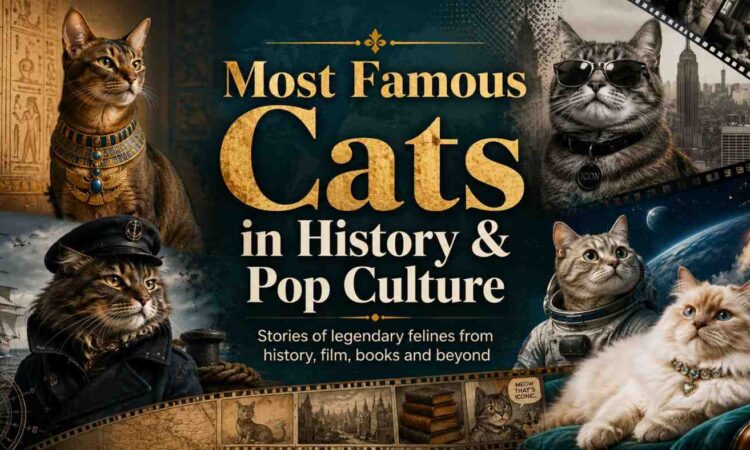
Cats have always had a special place in human imagination. They have been worshiped as sacred animals, welcomed aboard ships, celebrated in books, drawn into cartoons, turned into internet memes, and even sent into space. Unlike many animals that became famous through loyalty or obedience, cats often became icons because of their independence, mystery, humor, and unmistakable personality.
From the sacred cat symbolism of ancient Egypt to Garfield’s love of lasagna, from Tom’s endless chase of Jerry to Grumpy Cat’s unforgettable face, famous cats have shaped stories across centuries. Some were real animals who lived remarkable lives. Others were fictional characters who became part of childhood memories. A few became global internet celebrities simply by looking unusual, acting funny, or sitting in a cardboard box.
This article explores the most famous cats in history and pop culture, looking at why these legendary felines became so memorable and what their popularity reveals about the bond between humans and cats.
Why Cats Become Cultural Icons
Cats become famous for reasons that are very different from dogs, horses, or other animals. Dogs are often remembered for loyalty, service, or bravery. Cats, on the other hand, are remembered for mystery, attitude, elegance, and comic unpredictability. A cat can become iconic simply by sitting in the wrong place at the right time, refusing to cooperate, or staring at a camera with perfect indifference.
This is part of what makes cats so powerful in culture. They are close enough to humans to live in our homes, but independent enough to feel unknowable. They can be affectionate one moment and aloof the next. That contrast has made them ideal symbols for magic, royalty, rebellion, comfort, mischief, and internet humor.
Across history, cats have served many roles: pest controllers, sacred animals, ship companions, political mascots, cartoon troublemakers, children’s book heroes, and viral online celebrities. Their fame is not limited to one country or era. It stretches from ancient temples to modern social media feeds.
Ancient Egypt: Where Cats Became Sacred Symbols
Bastet and the divine image of cats
No discussion of famous cats in history can begin without ancient Egypt. Cats were deeply connected with Egyptian religious life, domestic life, and artistic symbolism. One of the most famous feline-associated figures was Bastet, an ancient Egyptian goddess who was first linked with a lioness form and later strongly associated with the domestic cat. Britannica describes Bastet as a goddess whose image shifted toward a cat after the domestication of cats in Egypt.
Bastet represented protection, fertility, music, joy, and the home. Her worship shows how cats were not just useful animals in ancient Egypt; they became spiritual symbols. The Metropolitan Museum of Art notes that Bastet’s main cult center was Bubastis, where large numbers of cat statuettes and cat mummies were discovered.
Why ancient Egyptian cats still fascinate us
Ancient Egyptian cats remain famous because they combine beauty, mystery, and sacred meaning. Statues of cats from Egypt often show them sitting upright, calm, alert, and elegant. This image still shapes the modern idea of cats as regal animals.
The Egyptian connection also helped create one of the longest-lasting cultural associations around cats: the idea that cats are more than ordinary pets. They are watchers, guardians, and symbols of hidden power. Even today, a cat with an elegant pose or piercing gaze can feel almost ancient.
Famous Real Cats from History
Trim, the explorer’s loyal ship cat
Trim was one of the most famous ship cats in history. He belonged to Matthew Flinders, the explorer and navigator who mapped much of the Australian coastline. Trim was born at sea in 1799 and accompanied Flinders during voyages connected to the circumnavigation and mapping of Australia from 1801 to 1803.
Trim became famous not only because he traveled, but because Flinders wrote about him with deep affection. In a world where exploration was dangerous and lonely, a ship cat could be more than a mouser. He could be a companion, a source of comfort, and a symbol of resilience.
Trim’s story shows how cats were part of maritime history. Ships carried cats to control rats, protect food stores, and bring luck to sailors. But Trim became something more: a remembered personality in the story of exploration.
Hodge, Samuel Johnson’s beloved cat
Hodge was the cat of Samuel Johnson, the famous English writer and lexicographer. Hodge became known through James Boswell’s biography of Johnson, where Johnson’s affection for his cat stood out as a memorable detail. Today, Hodge is remembered with a bronze statue outside Dr. Johnson’s House in London.
One charming detail often connected with Hodge is Johnson personally buying oysters for him. In modern times, oysters sound luxurious, but in 18th-century London they were common and inexpensive. The story matters because it shows Johnson’s tenderness toward an animal at a time when pet-keeping was becoming more recognizable in a modern sense.
Hodge’s fame is quiet but lasting. He was not a hero, performer, or meme. He became famous because a great writer loved him.
Unsinkable Sam, the legendary wartime cat
Unsinkable Sam, also known as Oscar, is one of the most legendary cats connected with World War II. According to the popular story, he survived the sinking of multiple ships, including the German battleship Bismarck and later British vessels. However, historians and naval sources have questioned parts of the story, and the full biography may include legend as much as fact.
That uncertainty is part of why Unsinkable Sam remains fascinating. Whether every detail is fully proven or not, the legend reflects how sailors viewed cats: as companions, survivors, and sometimes symbols of luck. In wartime, when life could change in seconds, a cat who seemed to survive disaster became a powerful story.
Unsinkable Sam represents a special category of famous cat: the half-historical, half-mythic feline whose story survives because people want to believe in it.
Cats in Science and Space
Schrödinger’s Cat and the world of quantum physics
Schrödinger’s Cat is not a real cat, but it may be the most famous scientific cat in the world. In 1935, physicist Erwin Schrödinger proposed a thought experiment involving a hypothetical cat in a sealed box to challenge ideas in quantum mechanics. The experiment is often used to explain the strange concept of superposition, where a system can be described as being in more than one state until observed.
The reason Schrödinger’s Cat became so famous is that it uses an everyday animal to explain a difficult scientific idea. Most people may not fully understand quantum mechanics, but they remember the image of a cat that is both alive and dead in a paradoxical situation.
This imaginary cat became a bridge between advanced physics and popular culture. It appears in science books, jokes, comics, TV shows, and internet discussions. Few thought experiments have produced such a memorable animal icon.
Félicette, the first cat in space
Félicette was a real cat, and her story is both remarkable and bittersweet. She became the first cat to reach space when France launched her on a suborbital mission on October 18, 1963. Guinness World Records states that Félicette reached an altitude of 154 km and was recovered unharmed after the flight.
Félicette’s mission was part of early space research, when animals were sent into space to study the effects of spaceflight on living bodies. Unlike many famous space animals, Félicette was forgotten by much of the public for a long time. In recent years, however, her story has received renewed attention as people recognize her place in space history.
She is one of the most important cats in history because she represents the strange intersection of science, exploration, and animal ethics. Her fame raises admiration, curiosity, and difficult questions at the same time.
Cartoon Cats That Defined Generations
Felix the Cat, one of animation’s earliest stars
Felix the Cat is one of the earliest and most important cartoon cats. He emerged in the silent-film era and became one of animation’s first major recurring animal characters. Felix’s simple black body, white eyes, and wide grin made him instantly recognizable.
Felix became famous before modern television, social media, or global merchandising as we know it. His success showed that an animated animal character could become a celebrity. He appeared in short films, comic strips, toys, and other merchandise.
Felix matters because he helped establish the idea of the cartoon animal superstar. Without early icons like Felix, later animated cats may not have found such a clear path into global entertainment.
Tom from Tom and Jerry
Tom, the scheming cat from Tom and Jerry, is one of the most famous animated cats of all time. Created by William Hanna and Joseph Barbera in 1940, the series centers on Tom’s endless pursuit of Jerry, a clever mouse. Britannica notes that the series was driven mostly by action and visual humor, with the characters rarely speaking.
Tom’s fame comes from his failure as much as his personality. He is dramatic, ambitious, emotional, and endlessly unlucky. His plans often collapse in spectacular ways, making him both villain and victim.
For generations, Tom represented slapstick comedy at its most expressive. His face, body language, screams, and exaggerated reactions made him unforgettable even without dialogue.
Garfield, the lasagna-loving comic legend
Garfield is one of the most commercially successful and widely recognized cats in modern pop culture. Created by Jim Davis, Garfield first appeared in 1978 and became known for his laziness, sarcasm, hatred of Mondays, and love of lasagna. Britannica describes Garfield as a worldwide sensation after his introduction in 1978.
Garfield’s reach is enormous. Guinness World Records lists Garfield as the world’s most syndicated comic strip, noting that it appeared in about 2,100 journals in 80 countries as of 2015.
What makes Garfield so famous is his human-like attitude. He is a cat, but his complaints feel very human: he wants comfort, food, sleep, and control. That combination made him relatable across cultures.
Famous Literary Cats
The Cheshire Cat
The Cheshire Cat from Lewis Carroll’s Alice’s Adventures in Wonderland is one of literature’s most mysterious cats. Known for his wide grin and ability to appear and disappear, the Cheshire Cat became a symbol of strange logic, riddles, and dreamlike storytelling. Britannica identifies him as a fictional character from Carroll’s 1865 novel.
The Cheshire Cat is famous because he is not just cute or funny. He is unsettling, philosophical, and magical. His disappearing body and lingering grin created one of the most memorable images in literary history.
Even outside the book, the phrase “Cheshire Cat grin” is widely understood. That shows how deeply this fictional cat entered language and culture.
Puss in Boots
Puss in Boots is one of the great trickster cats of folklore. The character appears in the fairy tale retold by Charles Perrault in Tales of Mother Goose in 1697. In the story, the clever cat uses charm, deception, and strategy to improve his master’s fortune.
Puss in Boots is famous because he turns the usual pet-owner relationship upside down. The cat is the mastermind. He is confident, stylish, and socially intelligent. He understands power, appearances, and persuasion better than many humans around him.
Modern adaptations have made Puss even more popular, but his roots go back centuries. He is one of the oldest examples of the clever cat as hero.
The Cat in the Hat
The Cat in the Hat is one of the most famous children’s book cats ever created. Written and illustrated by Dr. Seuss, the book was published in 1957 and features a mischievous talking cat who entertains two children on a rainy day.
This cat became iconic because he represents joyful chaos. He enters a quiet home and turns boredom into wild imagination. At the same time, the story balances fun with disorder, making children laugh while adults worry about the mess.
The Cat in the Hat helped shape early reading for generations of children. His tall striped hat, bow tie, and playful energy remain instantly recognizable.
Pop Culture Cats with Global Recognition
Hello Kitty and the power of kawaii culture
Hello Kitty is one of the most recognizable cat-like characters in the world, though Sanrio has famously described her as a little girl rather than a cat. Britannica states that Hello Kitty was created by Sanrio in 1974 and became a character whose likeness appears on hundreds of products worldwide.
This identity debate is part of Hello Kitty’s charm. She has whiskers, cat ears, and a feline appearance, yet her official character world presents her as Kitty White, a girl from London. That ambiguity has only made her more fascinating.
Hello Kitty’s fame is built on simplicity. Her face has no mouth, which allows people to project emotions onto her. She can feel happy, calm, nostalgic, fashionable, or comforting depending on context. That flexibility helped her become a global symbol of kawaii culture and character branding.
Mr. Bigglesworth and movie villain style
Mr. Bigglesworth, the hairless cat associated with Dr. Evil in the Austin Powers films, became one of cinema’s most memorable villain pets. The character plays on an older movie trope: the powerful villain stroking a cat while plotting something sinister.
What makes Mr. Bigglesworth memorable is the contrast between elegance and absurdity. A hairless cat looks unusual, dramatic, and slightly alien, which perfectly matches the exaggerated comedy of the films.
Although he is not as historically important as Garfield or Felix, Mr. Bigglesworth shows how cats can become visual shorthand in film. A cat in the arms of a villain instantly suggests control, mystery, and theatrical menace.
Salem Saberhagen and the talking black cat trope
Salem Saberhagen from Sabrina the Teenage Witch is another famous pop culture cat. As a talking black cat with sarcasm, magical history, and comedic timing, Salem became a favorite among viewers.
Salem reflects a long tradition of black cats being associated with witches, magic, and mystery. But instead of being frightening, he is funny, witty, and often more entertaining than the humans around him.
His popularity shows how pop culture can transform old superstitions into comedy. The black cat becomes not a bad omen, but a beloved companion with personality.
Internet Cats That Changed Online Culture
Grumpy Cat
Grumpy Cat, whose real name was Tardar Sauce, became one of the defining internet animals of the 2010s. Her fame began in 2012 when her frowning face spread online. The official Grumpy Cat site says she became a worldwide sensation after her image was shared on the internet, and a video helped prove the face was real.
Grumpy Cat’s expression made her perfect for meme culture. People used her face to express disappointment, sarcasm, negativity, and dry humor. Her fame expanded into merchandise, media appearances, and brand collaborations.
What made Grumpy Cat special was timing. She appeared when internet meme culture was becoming mainstream. She was not just a cute pet; she was a reaction image, a joke format, and a digital personality.
Lil BUB
Lil BUB became famous for her unique appearance, including large eyes, a small body, and a tongue that often stuck out. But her legacy goes far beyond looks. Lil BUB was a rescue cat with special needs, and her fame helped raise awareness and support for animals that are often harder to adopt. Her official fund states that Lil BUB’s Big Fund exists to advocate for companion animals with special needs.
The ASPCA also highlighted Lil BUB’s impact, noting that hundreds of animal shelters benefited from Lil BUB’s Big Fund.
Lil BUB became famous because she combined internet charm with a real mission. Her story turned viral attention into animal welfare support, showing that online fame can have meaningful impact.
Keyboard Cat and Nyan Cat
Keyboard Cat is one of the classic internet cat memes. The original video featured Fatso, a cat appearing to play a keyboard, with the famous “play him off” joke later becoming a popular meme format. The concept spread widely after being used at the end of fail videos and awkward clips.
Nyan Cat is another internet legend. It began as a 2011 YouTube video combining an animated cat with a Pop-Tart body, a rainbow trail, and a catchy song. The video became one of the most recognizable memes of the early 2010s.
Together, Keyboard Cat and Nyan Cat show two sides of internet cat culture. Keyboard Cat is funny because it feels like a performance. Nyan Cat is famous because it is absurd, colorful, repetitive, and perfectly suited to online sharing.
Maru, the box-loving Japanese cat
Maru, a Japanese cat famous for squeezing into boxes, became one of YouTube’s most beloved animal stars. Guinness World Records reported that Maru once held the record for most views for an animal on YouTube, with over 325 million views as of September 2016.
Maru’s appeal was simple and universal. He loved boxes. He jumped into them, slid into them, failed to fit into them, and somehow made ordinary cardboard hilarious.
Maru’s videos captured the essence of why cats dominate the internet: they do normal cat things with total seriousness, and humans find it endlessly funny.
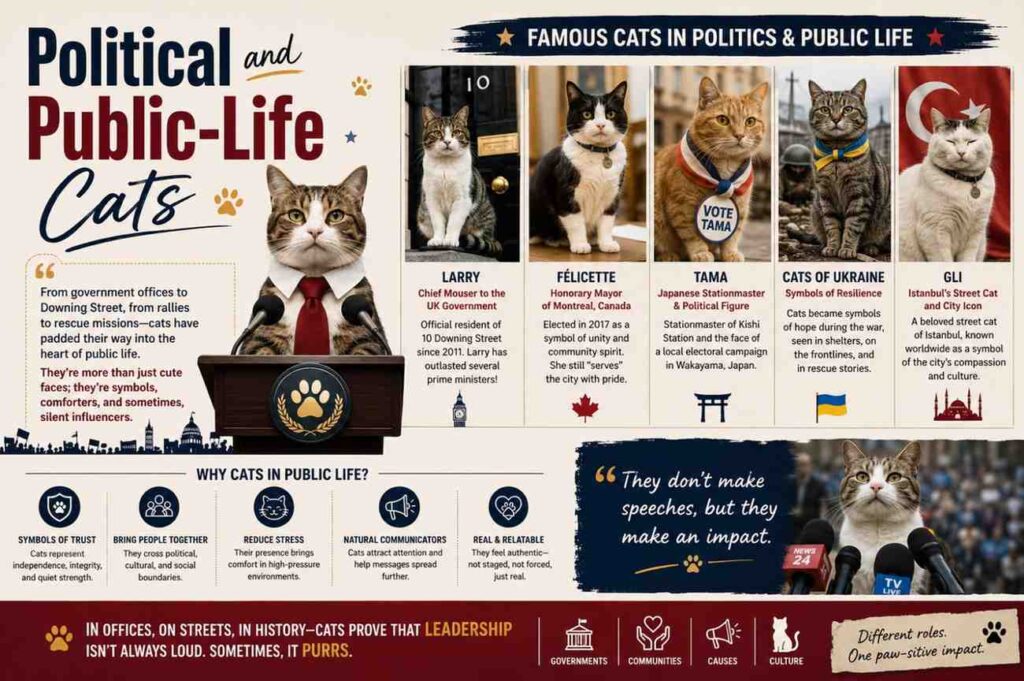
Political and Public-Life Cats
Socks Clinton, America’s famous First Cat
Socks Clinton was one of the most famous political cats in the United States. He was a stray tuxedo cat adopted by Bill and Hillary Clinton before moving into the White House in 1993. The Clinton Library describes Socks as one of the most well-known White House pets.
Socks became famous because he helped humanize the presidency. White House pets often make political families feel more relatable, and Socks did exactly that. He appeared in media coverage, photos, and even the children’s version of the White House website.
His fame shows how cats can become part of public identity. A political cat does not need to speak, campaign, or perform. Simply existing in a historic place is enough to become memorable.
Larry, Chief Mouser of 10 Downing Street
Larry is one of the most famous living public cats. He has served as Chief Mouser to the Cabinet Office at 10 Downing Street since 2011. Sources note that Larry has lived at Downing Street through multiple British prime ministers and is cared for by Downing Street staff rather than being the personal pet of the prime minister.
Larry’s fame comes from his position at the center of British politics. He is often photographed near the famous black door of 10 Downing Street, sometimes appearing during major political moments.
In a world of fast-changing leaders and serious news, Larry offers something different: calm, indifference, and feline continuity. He has become a symbol of stability, humor, and British political culture.
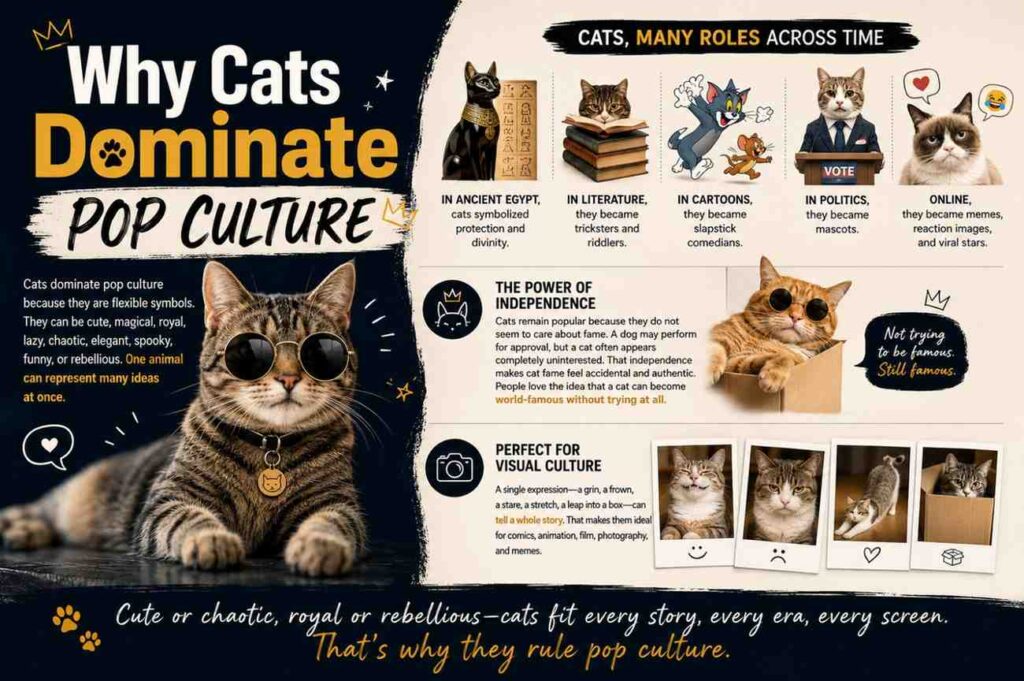
Why Cats Dominate Pop Culture
Cats dominate pop culture because they are flexible symbols. They can be cute, magical, royal, lazy, chaotic, elegant, spooky, funny, or rebellious. One animal can represent many ideas at once.
In ancient Egypt, cats symbolized protection and divinity. In literature, they became tricksters and riddlers. In cartoons, they became slapstick comedians. In politics, they became mascots. Online, they became memes, reaction images, and viral stars.
Another reason cats remain popular is that they do not seem to care about fame. A dog may perform for approval, but a cat often appears completely uninterested. That independence makes cat fame feel accidental and authentic. People love the idea that a cat can become world-famous without trying at all.
Cats also fit perfectly into visual culture. A single expression—a grin, a frown, a stare, a stretch, a leap into a box—can tell a whole story. That makes them ideal for comics, animation, film, photography, and memes.
What Famous Cats Teach Us About Humans
Famous cats are not only about cats. They reveal human values, humor, fears, and imagination.
Bastet shows humanity’s desire to connect animals with the divine. Trim and Hodge show the emotional bond between people and companion animals. Schrödinger’s Cat shows how humans use familiar images to explain difficult ideas. Garfield shows our love of laziness and sarcasm. Grumpy Cat shows how internet culture turns facial expressions into global language.
Every famous cat reflects the culture that made it famous. Ancient Egyptians saw protection and sacred power. Sailors saw luck and companionship. Children saw mischief and imagination. Internet users saw humor, irony, and emotional expression.
Cats become mirrors. We project mystery, comedy, comfort, rebellion, and wisdom onto them. That is why their fame lasts.
Conclusion
The most famous cats in history and pop culture are more than cute animals or entertaining characters. They are symbols of the human imagination. From ancient Egyptian temples to ship decks, from science labs to comic strips, from children’s books to viral videos, cats have repeatedly found their way into the center of human storytelling.
Some famous cats were real: Trim, Hodge, Félicette, Socks, Larry, Grumpy Cat, Lil BUB, and Maru. Others were fictional but deeply influential: Felix, Tom, Garfield, the Cheshire Cat, Puss in Boots, The Cat in the Hat, and Hello Kitty. Together, they show how cats can move between history, myth, science, entertainment, and digital culture.
Their fame continues because cats remain wonderfully difficult to define. They are domestic but independent, familiar but mysterious, playful but dignified. Whether worshiped, drawn, filmed, memed, or remembered in bronze statues, cats keep proving that they are not just pets. They are cultural icons.
FAQs
Who is the most famous cat in history?
There is no single answer, but Bastet’s sacred cat symbolism in ancient Egypt, Félicette’s space mission, and famous real cats like Trim, Hodge, and Socks are among the most historically important. In modern pop culture, Garfield, Hello Kitty, Tom, and Grumpy Cat are among the most widely recognized.
Who is the most famous cartoon cat?
Garfield is one of the most famous cartoon cats, especially because of his global comic strip success. Tom from Tom and Jerry, Felix the Cat, and The Cat in the Hat are also major cartoon and literary icons.
Was there really a cat sent to space?
Yes. Félicette, a French cat, became the first cat to reach space on October 18, 1963, during a French suborbital mission. Guinness World Records confirms that she reached 154 km and returned unharmed.
Why are cats so popular on the internet?
Cats are popular online because their behavior is expressive, unpredictable, and easy to share visually. Internet cats like Grumpy Cat, Keyboard Cat, Nyan Cat, Lil BUB, and Maru became famous because a single image or video could communicate humor, personality, or absurdity instantly.
Is Hello Kitty actually a cat?
Hello Kitty looks like a cat, but Sanrio has described her as a little girl named Kitty White rather than an actual cat. Britannica notes that Hello Kitty was created by Sanrio in 1974 and is one of the world’s most famous character brands.